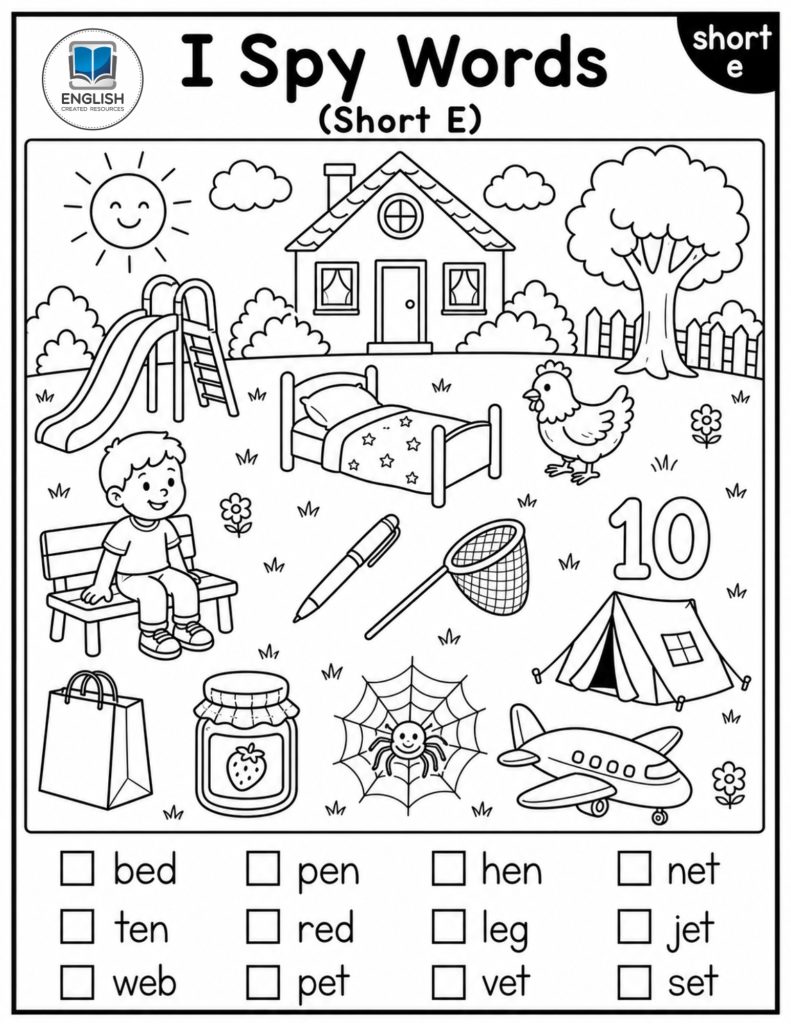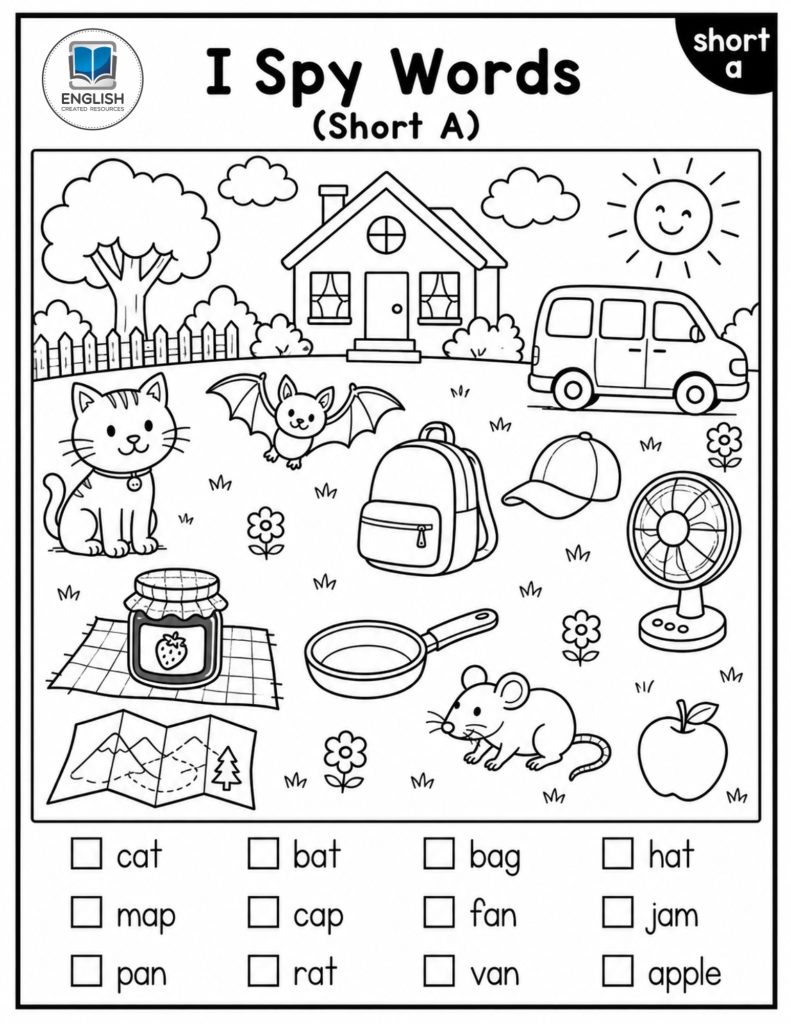

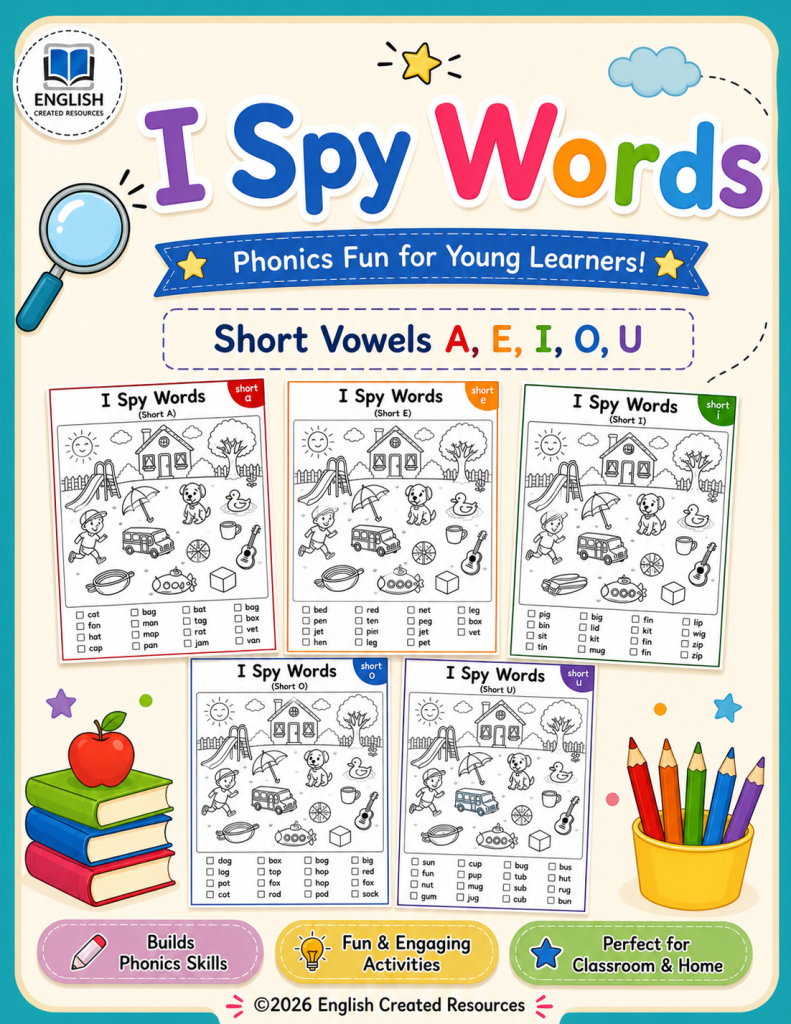
I Spy Words Short Vowels
I Spy Words activities that focus on short vowels play a powerful role in early childhood education, especially for preschool learners who are just beginning their journey into language and literacy. At this stage, children are naturally curious, highly visual, and eager to explore the world around them.
Introducing phonics through engaging, game-like formats such as I Spy worksheets allows educators and parents to build foundational reading skills in a way that feels enjoyable rather than instructional. This approach aligns with how young children learn best: through play, repetition, and meaningful interaction with their environment.
Short vowels are among the first phonetic concepts that children need to understand in order to decode words. Sounds such as /a/ in “cat,” /e/ in “bed,” /i/ in “pig,” /o/ in “dog,” and /u/ in “cup” form the building blocks of early reading.
These sounds appear in many simple, high-frequency words that children encounter in everyday life. When preschoolers are introduced to these sounds through I Spy Words activities, they begin to associate letters with sounds in a concrete and memorable way. Instead of simply memorizing letters or repeating sounds in isolation, they connect those sounds to real objects they can see and identify within a picture.
The visual nature of I Spy Words activities is particularly beneficial for preschool learners. Young children rely heavily on visual cues to make sense of new information. When they search for a “cat” in a busy picture or identify a “sun” among other objects, they are engaging in active observation and discrimination. This process strengthens their ability to notice details, compare shapes, and distinguish between similar items. These visual discrimination skills are not only important for reading but also for overall cognitive development.
Another important aspect of these activities is the development of phonemic awareness. Phonemic awareness refers to the ability to hear, identify, and manipulate individual sounds in spoken words. It is one of the strongest predictors of later reading success. Through I Spy Words, children repeatedly hear and say short vowel words while linking them to images. For example, when a child looks for a “dog,” they are likely to say the word aloud, hear the /o/ sound, and begin to recognize that this sound appears in other words as well. Over time, this repeated exposure helps them internalize sound patterns and build confidence in recognizing them.
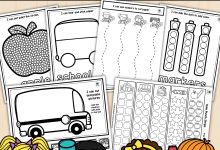
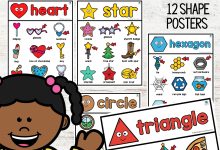
I Spy Words activities also support vocabulary development. As children explore the worksheet, they encounter a variety of familiar and sometimes new words. Each word is paired with a visual representation, which helps reinforce meaning and retention. For preschoolers, learning vocabulary is not just about memorizing words; it is about understanding how those words relate to the world around them. Seeing a picture of a “hat” or a “bus” while hearing the word strengthens the connection between language and real-life experiences.
In addition to language development, these activities promote important cognitive skills such as attention, memory, and problem-solving. Searching for specific items within a detailed picture requires children to focus their attention and ignore distractions. They must remember the target word, scan the image carefully, and verify whether what they see matches the word they are looking for. This kind of mental engagement supports executive functioning skills, which are essential for academic success later on.
Fine motor skills are another area that benefits from I Spy Words worksheets. Many of these activities involve circling, checking boxes, or coloring objects. These actions help children develop hand-eye coordination and control over small movements, which are necessary for writing. At the preschool level, strengthening fine motor skills is just as important as building cognitive and language abilities, as it prepares children for more advanced tasks in kindergarten and beyond.
One of the greatest strengths of I Spy Words activities is their ability to make learning feel like play. Preschool children are not typically motivated by traditional academic tasks, but they are highly motivated by games and challenges. When learning is presented in a playful format, children are more likely to stay engaged, persist through difficulties, and develop a positive attitude toward learning. This positive association with learning can have long-lasting effects, influencing how children approach education in the future.
These activities also provide opportunities for social interaction and guided learning. Teachers and parents can use I Spy worksheets as a tool for discussion, asking questions such as “What sound do you hear at the beginning of this word?” or “Can you find another word with the same vowel sound?” This kind of interaction encourages children to think critically, express their ideas, and learn from others. It also allows adults to assess a child’s understanding and provide support where needed.
Furthermore, I Spy Words activities are highly adaptable and can be used in a variety of settings. They can be incorporated into classroom centers, used as independent practice, or enjoyed at home as a fun learning activity. Their simplicity and flexibility make them an effective resource for diverse learning environments and different learning styles. Whether a child is a visual learner, an auditory learner, or a kinesthetic learner, these activities offer multiple ways to engage with the material.
Consistency and repetition are key elements in early literacy development, and I Spy Words naturally incorporate both. By repeatedly encountering short vowel words in different contexts, children reinforce their understanding and gradually build automaticity. This repeated exposure helps move knowledge from short-term memory to long-term memory, making it easier for children to recall and apply what they have learned.
In conclusion, I Spy Words activities centered on short vowels are a valuable tool for preschool education. They support the development of phonemic awareness, vocabulary, visual discrimination, attention, and fine motor skills, all within an engaging and playful format. By combining visual exploration with sound recognition, these activities help children build a strong foundation for reading and writing. More importantly, they foster a love of learning and curiosity that can inspire children as they continue their educational journey.
Samples From the Activities